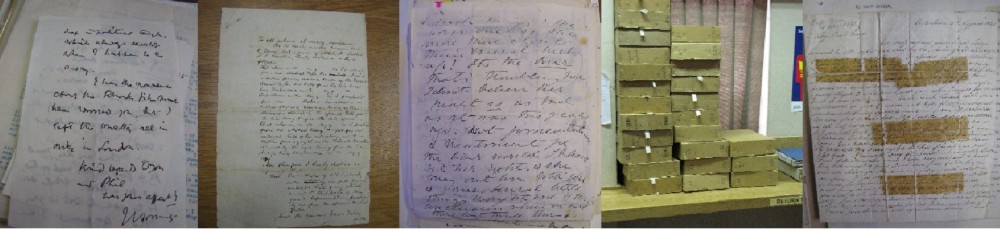
Forbes diary overviews
Please reference as: Liz Stanley (2019) ‘Forbes Diary Overviews’ www.whiteswritingwhiteness.ed.ac.uk/Collections/Collections-Portal/Forbes-Diary-Collection/Forbes-Diary-Overviews and provide the paragraph number as appropriate when quoting.
Guides to the Forbes diary are:
- The Forbes diary in a nutshell
- Introducing the Forbes diary
- Forbes diary dramatis personae
- Forbes diary overviews [this]
- Forbes diary: working conventions
1850 ‘Unicorn’
1. This is a migrant diary, concerning David Forbes’s journey from Scotland to South Africa on the ship ‘Unicorn’. From the way it has been written, it was perhaps intended to act as a kind of public record. However, that it is part of the Forbes Family Collection suggests it was retained by the writer.
2. The 1850 diary has a strong temporal structure. It begins with leaving Britain and ends with arrival just before landing in Natal; its entries are all dated; and it takes the form of a continuous time-based narrative overviewing events and occurrences rather than recording each day in a strictly delineated fashion. Clearly the entries have been written over time, given handwriting differences, but whether they were written specifically on the dates given cannot be ascertained.
3. There is little of ‘I’ in the 1850 diary; it is primarily about the doings of ‘we’ or the ‘they’ of other people. It is in particular concerned with the collective doings of ‘we’, although and interestingly the brother that David Forbes travelled with, Alexander or Alex, is not actually mentioned by name. It is also to a significant extent about goings-on on board the ship, which were often dramatic in character. This includes drunkenness, fighting, theft, a domineering ship’s captain and water privation.
4. Its writing style suggests that at this point in time David Forbes was on the literate side of functionally-literacy and relatively unpractised in writing, compared with his facility later in his life. In the 1850 diary, he also tends to use an all-purpose letter at the start of words, which could be a B, D, H and so on, while otherwise the tone of how he writes is recognisable in later diaries as well.
5. At the end of this diary, there are notes and lists in both his and Alexander Forbes’s hand-writings concerning mining and prospecting trips, and trading and related transactions, made in 1860-1.
6. All entries for the 1850 diary have been transcribed in full. Consequently, there are no separate summaries of entries.
7. NB. Whether other diaries no longer extant were written between 1850 and 1868 cannot be ascertained. However, the next extant diary in the collection is dated 1868.
1868
1. The 1868 diary has been written by Kate Forbes and is in a small leather-covered pocket-diary with printed pages. Its existence raises the question of whether she might have written a diary before this or in the ‘missing’ years after it. The 1868 entries concern travelling from the New Scotland area to Natal and Durban, then by ship to England and thence Scotland. The travellers include Kate and David Forbes and also Miss Pretorius, the daughter of President Pretorius of the Transvaal. By implication the Forbes daughters are travelling with them, although they are implicitly present only and it is likely that a purpose of the trip was to leave them in Edinburgh under the care of the eldest Forbes sister, Lizzie, to oversee their education there.
2. The entries start on 10 June 1868. The travelling party left Table Bay on 4 September and the entries record arriving in Southampton on 10 October. It is unclear, as the diary ends on this date, when they left for the return journey.
3. The entries over these dates are not continuous and breaks in recording are fairly frequent. In addition, the entries are mainly very short and schematic. Those written between 17 and 23 August might be in a different handwriting, or more likely Kate Forbes was trying to write when travelling. At the start of the diary, there are a number of entries recording cash and credits, but it is difficult to work out what these relate to although they do appear to be in her handwriting. To add to the time/writer complications, at the end there are accounts and lists which appear to be in the writing of the eldest Forbes brother, Alexander.
4. All entries for the 1868 diary have been transcribed in full. Consequently, there are no separate summaries of entries.
`5. NB. The next diary in the collection is dated 1870 in the inventory, although in fact there are two diaries in a notebook together, one for part of 1870 and the other for part of 1871. Whether other diaries which are no longer extant were written between 1868 and 1870-1871 cannot be ascertained.
1870-1871
1. The 1870 and 1871 diaries are both written by David Forbes snr. The contents are diverse and both are in what has once been a bound notebook, which has been used at different times by different people for different purposes as well as diary-writing. However, the cover no longer exists. At the start, it shows signs of Nellie (or, less likely given their ages at this time, another of the Forbes children) having used it for a range of purposes. It starts with drawings and poems that have been copied from an unknown source. The end of the notebook has also been used to copy out poems and draw things in the same hand. This is followed by a number of undated sheets in David Forbes snr’s handwriting which contain lists of sums of money for listed items, and seem to be an aide memoir concerning expenses.
2. There are two diaries within the notebook: one for part of 1870, and one for part of 1871. However, both are about trips away and are written by David Forbes; it seems that he took the notebook with him on these trips to make the entries.
3. The diary for 1870 is short and pencil-written and concerns the period of 2 to 17 August of that year, when David Forbes was on a trading trip. This is followed by a pen-written, mixed with intermittent pencil, diary for 10 April to 2 November 1871 when he was on a shared prospecting trip to New Rush (later Kimberley) and other diamond prospective areas.
4. Both diaries were written as continuous temporal narratives, and both lack the strong presence of an ‘I’ as a character in the writing. The 1870 diary is fully continuous, while the 1871 diary has one long gap and some shorter ones, including a physical gap where an entry is continued after a paper break. Both are scratty: there is no sign that they might have been written up after the event.
5. Both these shorts narrative diaries are of great interest, in different ways. Trading trips were regular feature of economic life in South Africa for David and Alexander Forbes, and they continued after David snr bought a farm, Doorn Kloof. The 1870 diary shows he went on one after the removal to New Scotland. Then by 1871 there was a kind of mass interest in the possibility of rich pickings in finding diamonds, particularly among the white settler community, but among many African groups as well although for somewhat different reasons. David Forbes’s 1871 diary was a prospecting trip shared with a number of other New Scotland men, and it has enormous interest in showing the day-to-day realities of what was involved, not just in prospecting but also in travelling to and between mining areas, and the effects on home life.
6. All entries for the 1870 diary have been transcribed in full. Because of this, there are no separate summaries of entries.
7. The inventory for the Forbes Family Collection, compiled by an archivist in 1957, indicates that at an earlier point a number of other diaries had existed for periods in 1858, 1866, 1869-1872, and 1875. These are no longer available, and inquiry indicates that at an earlier period a State Archivist lent them to a researcher and they were never returned. The next extant diary in the collection is therefore that dated 1882.
1882
1. The 1882 diary is in a bound printed diary with one page per week for entries. The main diary-writer is Kate Forbes, while it contains some entries when she was ill by David Forbes snr and a few by their eldest son Alexander jnr known as Alick. There are quite a few days for which no entries have been made. Where there are entries, these are frequently short and written very carefully, suggesting they might have been written up subsequently. However, the entries tend to become longer later in this diary, perhaps indicating some settling of style and purpose for the diary.
2. Content of the entries is particularly concerned with farming matters and the to-ing and fro-ing of people at Athole, and may be indicative of the start of the ‘farm diary’ approach. The comparative formality of how Kate Forbes writes entries also becomes apparent in this diary, with her referring in a formal way to her husband as Mr Forbes and other friends and family by also using formal titles.
3. There is no direct information as to why Alick Forbes took over writing the entries. There are a number of blank days before his first entry appears on 10 July, when he returned from staying with his aunt, Sarah Purcocks. This is dated 21 July. As he records that the farmhouse had been broken into while he was not there, by implication he was writing the diary because his parents were absent. However, that he does take over writing the diary, and previously David Forbes snr did when Kate was ill, shows there was a perceived element of requirement attached to writing the diary and that the entries were the responsibility of whoever was in charge at the time.
4. All entries for the 1882 diary have been transcribed in full. Because of this, there are no separate summaries of entries.
5. There is no indication of a Forbes diary having been written between 1883 and 1893, and none was recorded when the collection inventory was compiled in 1957. The next extant diary is dated 1893.
1893
1. The 1893 diary is written in a printed diary with one page for each day of the week. It starts in January and entries end in November that year, and there are a number of blank pages in addition and also some dates for which no entry has been recorded. The last item in this diary is actually dated 14 February 1894 and is a brief record of a financial matter, and it appears not to have been intended as a diary entry but a memorandum.
2. The 1893 diary is written neatly. Most of the spaces for entries are not filled completely and the entries are relatively short. There are also a number of blank pages as well as short entries. While the main writer of the 1893 diary is David Forbes snr, who wrote the large majority of its entries, Kate Forbes took over doing so during his absence, for example early in the diary when he and others went to the mining concession known as Forbes Reef in Swaziland.
3. The diary is mixed in terms of the kind of content recorded. In it, David Forbes writes two rather different kinds of entries: one that is more general and ‘conventional’ for a diary, with the other more schematic and focused on such things as sheep, oxen, ploughing, cattle and foaling, and animal sickness and deaths. The entries written by Kate Forbes are both fuller and more formal in how she refers to people, including ‘Mr Forbes’ for her husband and ‘Mrs Straker’ for her sister Sarah.
4. Along with the emphasis on the Estate and Home Farm, the entries give a sense of people visiting and the large amount of coming and going that occurred, conveying that people were very involved with each other in spite of the considerable distances between even ‘local’ places such as Athole, New Scotland (now Amsterdam) and Ermelo, and this at a point when people were dependent on horses and traps or the even slower ox wagon.
5. The only appearance of the ‘N-word’ in the Forbes diaries occurs in the entry for 28 February. This word was an Americanism ‘imported’ via US miners when in South Africa prospecting for diamonds and gold, and thence used for a short period of time by some South Africans, particularly those who had been in Kimberley and other mining areas.
6. All entries for the 1893 diary have been transcribed in full. Because of this, there are no separate summaries of entries.
7. There is no indication of a Forbes diary having been written between 1893 and 1900, and none was recorded when the collection inventory was compiled in 1957. The next extant diary is dated 1900.
1900
1. This is a large, hard-bound printed ‘library diary’ for another year, 1887, which has been made over to record 1900 entries. Days of the week are crossed out and replaced with the accurate (1900) ones, and the dates are preserved. It has spaces for two days of the week on each of its pages.
2. Thus this diary is labelled as 1900, but starts with 1887 printed materials followed by 1900 entries, and sometimes there are hand-written entries for 1887 and 1900 on the same page. Not surprisingly, at one point a mistake was made and the written-in date does not correspond with the accurate day of the week. It is surprising only that not more mistakes of this kind were made.
3. The main writer of the 1900 diary is David Forbes snr, although with a small number of entries by Kate Forbes when he was absent. The space for entries is not always filled and there are a few dates when nothing has been recorded, although some entries are packed.
4. Each of this diary’s large pages has space for two dated entries, as noted above. The content of entries is often mixed, with some being more like a ‘conventional’ diary and others more like the ‘farm dairy’ format which became standard after 1903. An early example on the same diary page concerns the entries for 26 and 27 October, and there are quite a few before and after these dates as well. This diary more clearly than earlier ones also records temperatures, winds and other weather events; and there is much detail on farming activity like hoeing, planting and fencing. It seems that aspects of the farm diary format were evolving at this time
5. Considering the distances involved between Athole and even ‘local’ places such as Amsterdam and Ermelo, a large number of people continued to visit either on a regular or more spasmodic basis. This occurred even after the South African War started, in October that year. The South African War is commented on in the diary, which contains increasing references to war news and rumour as well as the movements of troops in nearby areas. Some of the rumours circulating about this were ridiculous, in one case noted to be such in the diary, and are an indication of how cut off from realistic sources of news local people were.
6. Increasingly, in the latter months of the year there are extensive comments about illicit shooting on Athole land and poaching. These are detailed and much words space is given to identifying horses, guns, and the names of those involved. What comes across is the compilation in the diary of an official record that could be used to make and substantiate complaints about the Boer men concerned.
7. The diary-writer, David Forbes snr, describes the poachers as Dutchman and Boers and comments that the intention is to kill all his buck because of son Dave being involved with the British forces. However, a number of the names – such as Liversage – are clearly British ones and the poachers he manages to identify seem a more mixed group, of various local people, but also a group from Swaziland, some poverty-stricken families on trek passing, through and others.
8. All entries for the 1900 diary have been transcribed in full. Because of this, there are no separate summaries of entries.
9. From 1900 on, there is an extant diary for every year.
1901
1. This diary is written in an 1886 printed diary that has been made over for use in 1901. It starts at the beginning of the year and then ends with an entry on 18 February, the day that the Forbes left Athole for a refugee or concentration camp in Volksrust when their area of the Transvaal became part of the frontline of fighting and they were evacuated by British and colonial troopers. As part of this, many of their stock and horses were requisitioned, with others driven to the north by their sons Jim jnr and Dave jnr. Later the Forbes removed to a rented farm in a remote area of Natal where they spend the remainder of the war, while sons Dave joined the British troops and Jim stayed with their stock further north in Africa. In a very real sense, no one remained in charge of the Athole Estate, although many of the Forbes workers remained and continued to live as best they could in the difficult situation they were in, and the diary was not resumed until the return after the war ended, arriving back in later June 1901.
2. In spite of circumstances, this diary has an entry for every day over the period 1 January to 18 February 1901, although some are brief. These entries are largely concerned with two matters. One is the mass-arrival in the area of Boer commandos and British troops, and the emptying of farms and stocks and people in sweeps. The other is that, up to the last moment, the entries continue recording the ordinary life of farming activities, including hoeing and planting crops. The signs are that the evolution of the ‘farm diary’ format continued, with the emphasis on spare records of key farming events rather than being replaced by more topical matters.
3. All entries for the 1901 diary have been transcribed in full. Because of this, there are no separate summaries of entries.
4. It seems that no diary was written during the period the Forbes were away from Athole and their normal range of farming, business and other economic activities. The diary resumes in later 1902, as the Forbes returned to Athole.
1902
1. The 1902 diary is written on linked sheets of paper from a notebook and now without a cover. Its first seven pages are by Kate Forbes and entries concern the journey back to Athole from Natal. Her first entry is dated 15 July and her last is dated 25 August. Her entries are very densely written, and the content is a kind of travelogue of the return and first arrival. The entries for the rest of the year to 31 December are by David Forbes snr.
2. David Forbes snr’s first entry begins immediately following Kate’s last entry above it; it is undated but not a continuation of her entry. After this, the next entry he writes is dated 8 September 1902, so it is likely that this first one was written on 7 September or a day or two earlier. From being more spasmodic, the entries then become consecutive and are completed for each day. These entries, too, are a kind of travelogue of what they found when they returned and what they did during the period immediately after they arrived back.
3. There is considerable detail about the extent of the damage done, the repairs and then rebuilding. Athole was badly damaged, while neighbouring Westoe seems to have been more or less destroyed, so that it was very difficult for Sarah Straker nee Purcocks, Kate’s sister, to live there and she spent much time at Athole. These entries are also concerned with troubles, not just the repairs but the sense that the Forbes had been punished by being treated particularly badly by members of the local Boer populous and this was still continuing. Almost immediately, these troubles recur, as local Boers had plundered the house and the Estate as well as trespassing and shooting buck in a way that they treated as their right. The entries also record a Forbes association with Alfred Milner and other political figures and the post-1902 activities to transform Transvaal governance under British rule.
4. Over the period of the 1902 diary-entries, Dave jnr and Jim jnr were away doing things to bring back cattle, horses et cetera and then return, while Nellie, Kitty and Madge are referred to but not major players in what is recorded. Overall, there is a sense that the Forbes are more isolated than pre-war, there are fewer visitors and those that there are tend to be associated with the British presence, and the troubles referred to above punctuate more ordinary activities.
5. All entries for the 1902 diary have been transcribed in full. Because of this, there are no separate summaries of entries.
1903
1. The 1903 diary is contained in a large-format ‘library diary’ with one page allocated per day for entries. The main diary writer is David Forbes snr. However, during a period of his illness in mid-July, entries written by Kate Forbes until 14 August. Then on 15 August, Maggie Forbes wrote entries until 13 September, when David Forbes joined by Kate Forbes were both in Pretoria.
2. A notable feature of the 1903 diary is that the Forbes daughters become increasingly involved in a very hands-on way in farming activities, including taking charge of groups of workers, running parts of the Estate, organising activities for much of the Home Farm and its produce. While initially this is recorded mainly for Nellie and Maggie, after her 1909 marriage to Henry Rawson, their sister Kitty took over one of the Estate farms close to Athole and became a renowned farmer.
3. This diary also records the involvement of David Forbes snr in the Transvaal Labour Commission appointed by Alfred Milner, which was concerned with balancing the interests of farmers and the business community in particular in minerals in relation to their labour requirements, with him representing both. Dave jnr was at this point a labour recruiter and organiser in mining as well as continuing his other activities and he gave evidence to the commission.
4. When David Forbes snr was ill around 26 April, Kate Forbes recorded the diary-entries and continued to include temperature ranges and rainfall. By 19 July, wind direction and strength were also recorded by her. This continued, for even when the diary was written by Maggie Forbes, temperature ranges were still recorded and there are clear signs of the diary following a ‘farm diary’ format.
5. 1903 is a key diary regarding the development of the ‘farm diary’ structure, the components and likely origins of which are discussed in a separate document, on ‘The Forbes diary in a nutshell’. By mid-January, rain is being recorded fairly consistently, although not always. By 26 January, there is evidence of the template structure for writing an entry. By 26 February, rain is recorded at the bottom of the entry. And by 4 May, temperature ranges are being recorded. In addition regarding the structure of entries, at various points the entries for this year include notes at the bottom of the page that briefly record bills and other financial transactions, although recording this was short lived.
6. From the 1903 diary on, the Forbes diary is kept in a more rigorous way, entries contain more detail and also tend to be longer, and are written on effectively all days of the year. To cope with this large increase in volume of material from 1903 on, entries in the Forbes diaries thereafter have been sampled rather than all being fully transcribed. There are summary notes on all entries across the subsequent diaries, while this sample is composed by a smaller number of entries regarding which the content has been transcribed in full. For details of the sampling criteria used, see the separate document on ‘Forbes diaries sampling’.
1904
1. The 1904 diary is contained in a large-format ‘library diary’ with one page allocated per day for entries. Its entries are principally written by David Forbes snr, although some are by Kate Forbes, while Maggie Forbes wrote the diary when both parents were away (from 11 to 21 February).
2. The initial entries are written by Kate Forbes and contain a 7 January 1904 comment about her sending for a new diary, so this may indicate she wrote these early entries retrospectively once it arrived. The entries by David Forbes snr start in February 1904. Over the course of the diary, they become shorter and are half a page rather than a whole page in length, and a number of them are a few lines each. There are also some dates in May where there are no entries at all and no reason (travel etc) is given for this. With hindsight knowledge, it is possible to relate this to the development of the problems that led to David Forbes snr’s death the following year, likely to have been stomach or bowel cancer.
3. The recording of temperature ranges continues in almost all entries, and that of rainfall more spasmodically. However, some entries like that of 16 January 1904 follow the farm diary format and also record both temperature ranges and rainfall.
4. The entries are a mixture of the quotidian recording of unfolding live on the Estate, and larger events. These include ‘troubles’ with a hired white worker behaving in a racially offensive way to key Athole workers and being dismissed, a bitter marital dispute between one of the key workers, Bismark, and his wife Nomalanga, and the suicide one of the younger male members of the Walker family, prominent in the local settler community.
5. From 1903 on, entries in the Forbes diaries have been sampled, including for 1904. From 1903 on, the Forbes diary is kept in a more rigorous way, entries contain more detail and also tend to be longer and effectively on all days of the year.
6. To cope with this large increase in volume of material, entries in the Forbes diaries thereafter have been sampled rather than fully transcribed. There are summary notes on all entries across the subsequent diaries, while the sample concerns a smaller number of entries regarding which the content has been transcribed in full. For details of the sampling criteria used, see the separate document on ‘Forbes diaries sampling’.
1905
1. By later 1904 and 1905, the diary entries have taken on a clear episodic structure that follows the farm diary format, including with the daily temperature range and rainfall recorded at the end. The entry for 7 January 1905, for example, has eight interconnected elements – a thunderstorm and its effects, a grubber (a machine for weeding) starting work, worker Bismark harrowing, the return of Kitty and Maggie from a visit, Dave being away, Mr Abbott staying in the night, fencing posts and mealies, and a horse having a foal – plus temperature range and rain. By middle to late September, Kate Forbes is writing all the entries, and the episodic farm diary structure is in place and marks all the diaries as their basic format from then on, although there are points when the narrative format is discernible.
2. There is evidence in many entries that the farm diary format was a considered matter of how and what information should be recorded. Thus the entry for 25 July 1905 provides an example of the entry’s specific contents, and the record of temperature range and rainfall are written with a different pen and and/or different ink. This provides a strong hint that pages were set up in advance, and with the omnipresence of these weather measures in entries suggesting that someone had worked through the diary and provided headings for them in advance of any detailed content being written.
3. The entry for 14 November 1905 by Kate Forbes records the death of David Forbes snr. It registers emotion in a very controlled way and is all the more moving because of this. It does not have an episodic farm diary format, but a closely written narrative one, and it neither records temperature range nor rain. However, on 16 November recording temperatures and rainfall resumes, as does writing according to the farm diary format albeit punctuated by expressions of grief.
4. From 1903 on, entries in the Forbes diaries have been sampled, including for 1905. From 1903 on, the Forbes diary is kept in a more rigorous way, entries contain more detail and also tend to be longer and on effectively all days of the year. To cope with this large increase in volume of material, entries in the Forbes diaries thereafter have been sampled rather than fully transcribed. There are summary notes on all entries across the subsequent diaries, while the sample concerns a smaller number of entries regarding which the content has been transcribed in full. For details of the sampling criteria used, see the separate document on ‘Forbes diaries sampling’.
1906
1. The 1906 diary is a hard-bound and large page per day diary. From the start this is written around the farm diary episodic structure, the elements of which were noted above. Overwhelmingly the entries are provided by Kate Forbes, although another hand, most likely that of Maggie Forbes, writes while she is away with Kitty in Ermelo from 13 to 19 March. Kate Forbes then resumes writing on 20 March 1906.
2. Over this short period when Maggie Forbes wrote the entries, their content is pared down to minimal episodic detail, indicating the main elements considered important to record. The entries made by Kate Forbes, however, are more detailed and longer and the majority of the pages are filled. Examples are 4 January 1906, which briefly records eight separate pieces of information plus temperature range and rain; and 10 September 1906, which records in more detail six separate pieces of information plus temperature range and rain.
3. While focused on the Estate and Home Farm, the content of entries is very varied. It includes the activities of workers and family members, the to-ing and fro-ing of visitors, and also includes the smaller and larger events which punctuate the annual unfolding of the farming calendar. These include rumours of a ‘Native uprising’, the first circulation of news about the Bambatha rebellion in Natal to reach the New Scotland area, a number of the Kolwa or Christian workers on Athole are married, Bismark’s son Moses is badly burned in an accident and is treated by Kate Forbes, and a rather mysterious bitter controversy breaks out between different members of the local library committee, likely due to underlying political differences.
4. From 1903 on, entries in the Forbes diaries have been sampled, including for 1906. From 1903 on, the Forbes diary is kept in a more rigorous way, entries contain more detail and also tend to be longer and on effectively all days of the year. To cope with this large increase in volume of material, entries in the Forbes diaries thereafter have been sampled rather than fully transcribed. There are summary notes on all entries across the subsequent diaries, while the sample concerns a smaller number of entries regarding which the content has been transcribed in full. For details of the sampling criteria used, see the separate document on ‘Forbes diaries sampling’.
1907
1. The 1907 diary entries are written in a hard-covered printed diary with one page per date. Kate Forbes has written the large majority of entries, although another hand, most likely that of Maggie Forbes, has written those for 27 November to 8 December while Kate was away in Durban. There are also a number of loose sheets of letter-writing paper with diary entries on them placed into the printed diary volume. These provide insights into different aspects of the diary-writing process.
2. There are some inserted loose sheets on letter-writing paper placed between the 3 and 4 January 1907 entries. However, these are actually diary entries rather than letters, in spite of the paper, and are dated 3 January, 4 January, 12 January and 13 January 1907, and they are in Kate Forbes’s handwriting. They parallel a number of the printed diary entries, suggesting that she wrote entries on loose sheets of letter-paper and then transferred them into the diary-book.
3. There also interesting letter/letter-like complications regarding some June and July entries. There are, for instance, letter-like insertions on letter paper, headed ‘Diary June 1907’ in Kate Forbes’s writing but with the actual entries, dated from 20 June to 4 July, written in hand which is neither hers not that of Nellie or Maggie Forbes, but Robin Forbes. Also these entries were not duplicated in the diary, just placed in it at an appropriate point. However, entries in the printed diary in Kate Forbes’s writing are made the dates on the insert sheets but they do not copy or duplicate the content of these. At the top of each of these has been written – as for example on 1 July – ‘Robin kept diary’. And the complications continue, for the content she recorded does not concern where she physically was, but provides truncated summaries of activities at Athole.
4. Over the period that Kate Forbes was absent from Athole on this occasion, her unmarried daughters Nellie and Madge were with her, while the whereabouts of Kitty at this time is not known. A cousin at remove, Robin Forbes, was working for the Forbes long-term at this point and had been left in charge and so was responsible for the farm diary as well as the activities recorded. However, it seems that Kate Forbes retained a sense both of her responsibility for both the farm and the farm diary, giving rise to the parallel sets of entries.
5. As with all the diaries from 1903 on, once developments in the direction of the farm diary format had occurred, structural matters about the shape or structure of entries remain largely the same and it is specific content that changes over the course of the year, and over the course of one year after another. A particularly interesting aspect is revealed by reading across the diaries from around 1904 and 1905, after the death of David Forbes snr.
6. Kate Forbes was not a ‘settler wife’ in a stereotypical sense. She ran the Forbes farm and later the Athole Estate in the absences of David Forbes on trading and prospecting trips. And from letters as well as diaries, she played a very active role in not only running the household, the farmhouse and kitchen garden, but also significant aspects of the Home Farm’s activities. After the death of David Forbes snr, many diary entries show that she took on all the responsibilities he had had, and she had a very definite sense of being in charge and not to be crossed because she was a woman, something that later surfaced in the relationship between her and various managers employed at Athole. Kate Forbes continued to see herself as fully responsible for the Forbes economic enterprise into old age, including when contemplating how to manage the re-distribution of Forbes property in her Will.
7. From a young age, the Forbes male children Alick (who died in 1882), Dave and Jim were given parcels of land and stock, and also became geographically more mobile and did more things than be tied to the Athole Estate. Interestingly, the female children – Nellie, Kitty and Madge or Maggie – were in an even-handed way also given parcels of land and stock, although presumably for safety reasons they were less geographically mobile then their brothers. However, when David snr died there were significant changes in this pattern. Dave and Jim began to spend more time and became more pro-active at Athole and surrounding farms in the Estate; and Nellie, Kitty and Madge come much more into frame in the diary and are recorded as taking a very hands-on responsibility for many aspects of Athole’s operations, including managing groups of workers and spending days in carrying out major activities with them.
8. From 1903 on, entries in the Forbes diaries have been sampled, including for 1907. From 1903 on, the Forbes diary is kept in a more rigorous way, entries contain more detail and also tend to be longer and on effectively all days of the year. To cope with this large increase in volume of material, entries in the Forbes diaries thereafter have been sampled rather than fully transcribed. There are summary notes on all entries across the subsequent diaries, while the sample concerns a smaller number of entries regarding which the content has been transcribed in full. For details of the sampling criteria used, see the separate document on ‘Forbes diaries sampling’.
1908
1. The 1908 entries are in a hard-covered printed diary with one page per date. The entire diary is written by Kate Forbes. The episodic farm diary format has the same clear presence as in previous years, although the entries tend to be half a page in length rather than filling the entire page. There are also some occasional more narratively structured entries or part-entries concerned with events that are out of the ordinary. Another interesting development in the 1908 diary is that occasionally there are margin notes that provide a succinct summary of the adjacent paragraph and which act as a kind of index to items which are thereby picked out. This indexing aspect becomes institutionalised as a regular feature of the daily entries in later years.
2. There are entries for 24 and 25 January 1907 which have been written on letter-writing paper and inserted into the bound diary. These are overwhelmingly the same, with just differences of a word here and there, as the entries which have been written onto the diary pages. This provides further indication of the likelihood that Kate Forbes wrote many entries on sheets of paper and later transferred these into the diary proper.
3. There are a number of inserted pages at the end of the diary with entries on loose sheets for 7 January 1908 and various other dates. These are all for the month of January and have been copied into the bound diary but minus the mistakes that exist in the letter-writing versions, providing conclusive indication that writing a day’s events on loose sheets and then copying them into the bound diary was the order of things on at least some occasions.
4. As noted earlier, once structural developments in the direction of the farm diary format had occurred, structural matters about the shape or structure of entries remain largely the same and it is specific content that changes over the course of the year, and over the course of one year after another. A number of smaller and larger events marked and differentiated particular days and periods of time within the unfolding annual round of farming activity over the course of 1908. There were baptisms of some of the Kolwa/Christian workers at Athole, Sarah Straker experienced severe ill-health due to gallstones, and one of the inner group of workers, Potolosie, began to experience the signs of severe mental illness. There was a government enquiry into roads through local farms, with the Forbes fending off attempts by Boer neighbours to gain access through their property. There were also discussions as to ‘an agreement how this place is to be divided when the time comes’ (6 June 1908), referring to the distribution of property when Kate died.
5. From 1903 on, entries in the Forbes diaries have been sampled, including for 1908. From 1903 on, the Forbes diary is kept in a more rigorous way, entries contain more detail and also tend to be longer and on effectively all days of the year. To cope with this large increase in volume of material, entries in the Forbes diaries thereafter have been sampled rather than fully transcribed. There are summary notes on all entries across the subsequent diaries, while the sample concerns a smaller number of entries regarding which the content has been transcribed in full. For details of the sampling criteria used, see the separate document on ‘Forbes diaries sampling’.
1909
1. The 1909 entries are in a hard-covered printed diary with one page per date. The entire diary is written by Kate Forbes. The episodic farm diary structure has the same dominating presence as in previous years. There is a mixture of shorter and longer entries, while generally they are around two-thirds of a page in length.
2. The appearance of entries provided with margin notes as a kind of summarising index, which started in 1908, continues in more marked way during 1909. From differences in pen and ink and the often cramped writing these are made in, they appear to have been written after the entry itself rather than together with it.
3. The 1909 entries focus more on farming matters than previously, but by around mid-August entries are reduced to single lines each on up to eight or nine topics, as for example with that of 20 August. These entries were written during the time that Kate Forbes, following an illness, was away in Durban and someone was sending her information about the farm and its key activities. This continues until around 11 October. By 18 October there is a more usual entry by her. It is clear, then, that even while she is away Kate Forbes retained the perception of herself as in charge, and required being supplied with the key information that needed recording in the diary.
4. As noted earlier, once developments in the direction of the farm diary format had occurred, structural matters about the shape or structure of entries remain largely the same and it is specific content that changes over the course of the year, and over the course of one year after another. A number of smaller and larger events marked particular days and periods of time within the unfolding annual round of farming activity over the course of 1909. Kitty’s wedding to Henry Gilbert Rawson took place, with clear reservations being expressed by Kate Forbes about this in diary entries, a very atypical intrusion of the personal into her style of writing. Kate herself spent a significant period in Durban due to illness. And on a wider canvas, Dave jnr was involved in negotiating (to failed effect) about the route of a proposed railway line to Ermelo.
5. From the 1903 diary on, entries in the Forbes diaries have been sampled, including for 1909. From 1903 on, the Forbes diary is kept in a more rigorous way, entries contain more detail and also tend to be longer and on effectively all days of the year. To cope with this large increase in volume of material, entries in the Forbes diaries thereafter have been sampled rather than fully transcribed. There are summary notes on all entries across the subsequent diaries, while the sample concerns a smaller number of entries regarding which the content has been transcribed in full. For details of the sampling criteria used, see the separate document on ‘Forbes diaries sampling’.
1910
1. The 1910 entries are in a hard-covered printed diary with one page per date. The entire diary is written by Kate Forbes. The episodic farm diary structure has the same clear presence as in previous years. Entries mainly fill the majority of space on the page, although there are occasional short entries, and while some are longer, still everything is recorded on just one page. A typical example is 13 August. At the end of the 1910 diary there are some interesting pages recording cash payments made and owed, and these include both members of family as well as workers.
2. As noted earlier, once developments in the direction of the farm diary format had occurred, structural matters about the shape or structure of entries remain largely the same and it is specific content that changes over the course of the year, and over the course of one year after another. A number of smaller and larger events marked and differentiated particular days and periods of time within the unfolding annual round of farming activity over the course of 1910. There were a number of weddings, of both Kolwa workers and members of the white settler community. Halley’s comment was visible for an extended period and received many comments. And Sarah Straker continued to experience much ill-health, probably due to the onset of breast cancer.
3. From 1903 on, entries in the Forbes diaries have been sampled, including for 1910. From 1903 on, the Forbes diary is kept in a more rigorous way, entries contain more detail and also tend to be longer and on effectively all days of the year. To cope with this large increase in volume of material, entries in the Forbes diaries thereafter have been sampled rather than fully transcribed. There are summary notes on all entries across the subsequent diaries, while the sample concerns a smaller number of entries regarding which the content has been transcribed in full. For details of the sampling criteria used, see the separate document on ‘Forbes diaries sampling’.
1911
1. The 1911 entries are written in a hard-covered printed ‘library diary’ with one page per date. The entire diary is written by Kate Forbes. The episodic farm diary format has the same presence as in previous years. The entries are a mixture of whole page filled and shorter entries, and there are also some blank dates where no entry has been written.
2. There was a Forbes trip in August to visit Pretoria and Johannesburg and from there to the Victoria Falls, during which time there are just one or two entries, including a few skeleton comments about the farm. In later months of the year there are also many entries which refer to the illness of Sarah Straker nee Purcocks and one or other of the Forbes visiting or staying with her at her farm Westoe.
3. Towards the end of the diary, a series of pages record both cash transactions for goods and services, and transactions regarding people and cattle of different kinds. There are also some further pages that record other cash transactions relating to people in and around Athole.
4. As noted earlier, once developments in the direction of the farm diary format had occurred, structural matters about the shape or structure of entries remain largely the same and it is specific content that changes over the course of the year, and over the course of one year after another. A number of smaller and larger events marked and differentiated particular days and periods of time within the unfolding annual round of farming activity over the course of 1911. In terms of the momentous changes to property, finances and activities that occurred in its wake, this diary records the final illness of Sarah Straker.
5. From 1903 on, entries in the Forbes diaries have been sampled, including for 1911. From 1903 on, the Forbes diary is kept in a more rigorous way, entries contain more detail and also tend to be longer and on effectively all days of the year. To cope with this large increase in volume of material, entries in the Forbes diaries thereafter have been sampled rather than fully transcribed. There are summary notes on all entries across the subsequent diaries, while the sample concerns a smaller number of entries regarding which the content has been transcribed in full. For details of the sampling criteria used, see the separate document on ‘Forbes diaries sampling’.
1912
1. The 1912 entries are in a hard-covered printed ‘library diary’ with one page per date. The entire diary is written by Kate Forbes. The episodic farm diary structure has the same clear presence as in previous years.
2. The entries are a mixture of longer and shorter entries, and for quite a few entries temperatures and rain are not recorded. This is because Kate Forbes was that this time preparing to depart South Africa for Europe, leaving in May for an extended visit with her sons, Maggie and Robin Forbes to Mozambique for trekking and animal shooting, and from there travelling to Britain, arriving on 17 July. The entries then jump to 25 December when the Forbes party is in Edinburgh with Lizzie Forbes. The following entry for 26 December 1912 records them leaving Edinburgh for London and thence the return journey to Athole. This diary therefore does not cover the entire year because of this gap in entries, although the Mozambique part of the trip is recorded.
3. An earlier comment indicated that family divisions of labour seem to have changed significantly following the death of David Forbes snr, with the Forbes daughters recorded as playing a higher profile role regarding the management and hands-on work of estate property, farming and stock. In this connection, there are some relevant inserted sheets of paper in the February entries. These are dated 2 February 1912 and they record in some detail stockholding by ‘House’ and also by different family members, and which of the herds is looking after them. They show that Kitty in particular was a significant presence in this activity.
4. As noted earlier, once developments in the direction of the farm diary format had occurred, structural matters about the shape or structure of entries remain largely the same and it is specific content that changes over the course of the year, and over the course of one year after another. A number of smaller and larger events marked and differentiated particular days and periods of time within the unfolding annual round of farming activity over the course of 1912. The most consequential concerns the death of Sarah Straker in January 1912, with this both an occasion for grief and also the source of much rearrangement of property and finances, with many meetings about her Estate noted. The Mozambique trip and the unrecorded visit to Britain and stay with Lizzie Forbes are also among important events in this year.
5. From 1903 on, entries in the Forbes diaries have been sampled, including for 1911. From 1903 on, the Forbes diary is kept in a more rigorous way, entries contain more detail and also tend to be longer and on effectively all days of the year. To cope with this large increase in volume of material, entries in the Forbes diaries thereafter have been sampled rather than fully transcribed. There are summary notes on all entries across the subsequent diaries, while the sample concerns a smaller number of entries regarding which the content has been transcribed in full. For details of the sampling criteria used, see the separate document on ‘Forbes diaries sampling’.
1912 ^and 1913^
1. The 1912/1913 entries are in a hard-covered printed diary with two pages per week and so quite a confined space to record the daily entries. It is printed as 1912 and has a hand-written note on its cover by Kate Forbes stating ‘and 1913’. However, it is in fact entirely a 1913 diary and the dates have been hand-amended so that they reflect 1913 dates.
2. This diary has been written mainly by Dave Forbes jnr; Kate Forbes wrote only the entries for 1 to 4 April. The way the diary is written by him strips down the entries to the key elements of the farm diary format, which are written incredibly sparely. An example is provided by the entries for 2-3 January 1913, with others found all the way through.
3. As noted earlier, once developments in the direction of the farm diary format had occurred, structural matters about the shape or structure of entries remain largely the same and as already commented are pointed up in the kind of truncated version that appears in this diary. It is specific content that changes over the course of the year, and over the course of one year after another. A number of smaller and larger events marked and differentiated particular days and periods of time within the unfolding annual round of farming activity over the course of 1913, although this is barely registered in the way these entries have been written although it is shown by comparing this diary with the ‘1913 proper’ diary by Kate Forbes.
4. In terms of the Forbes diary database, this ‘1912 ^and 1913^’ diary has been treated slightly differently from others written from 1903 to 1917. It has been transcribed in full because making notations of its entries would be longer than the entries themselves are. The entries are not only very clipped and bullet-point like, but are generally not written in proper sentences and on occasions do not to have verbs and other such grammatical features. Therefore any notations would need to expand the form of their expression, and the result in many cases would be longer than what Dave himself wrote.
5. Given this, the decision was made to provide transcriptions, which can most helpfully be seen as Dave Forbes’s notations of what he thought the farm diary entries should be like. However, apart from this, the selection criteria for identifying some entries as ‘Sample’ have been used regarding the ‘1912 ^and 1913^’ diary. For details of the sampling criteria, see the separate document on ‘Forbes diaries sampling’.
1913
1. This diary is printed as a hard-covered scribbling diary for 1913, with two pages provided for the entries for each week, so writing space is fairly confined. Its earlier pages have been torn out and the entries, all in Kate Forbes’s handwriting, start on 5 April and continue to the end of the year. The length of the entries becomes shorter and more schematic as the months pass, and almost like bullet points. However, temperature range and rain are still recorded at the end of even shorter entries. The strong possibility, given that the entries concern Athole matters, is that, even though away convalescing, Kate Forbes continued to record these from information provided her by managers and adult children, so that this diary by her should be read in tandem with the other 1913 diary written by Dave jnr.
2. Because of the page size for the entries and the short points format, content is very focused. For example, the entry for Tuesday 6 May 1913 in summary is: Dave been to discuss the Estate of Sarah Straker, workers are making furrows, workers are carting manure, dealing with forage, McNamara watering barley, sending Kitty butter, temperature range. The effect is indeed bullet-like and in structure very similar to the 1913 diary as kept by Dave Forbes jnr.
3. As noted earlier, once developments in the direction of the farm diary format had occurred, structural matters about the shape or structure of entries remain largely the same and as already commented are pointed up in the kind of truncated version that appears in this diary. It is specific content that changes over the course of the year, and over the course of one year after another. A number of smaller and larger events marked and differentiated particular days and periods of time within the unfolding annual round of farming activity over the course of 1913. On a local scale, a long-term manager at Athole, McNamara, became disaffected and threatened to leave, eventually doing so the next year. On a wider scale, the national railway and mining strikes and events around them are covered.
4. From 1903 on, entries in the Forbes diaries have been sampled, including for 1913. From 1903 on, the Forbes diary is kept in a more rigorous way, entries contain more detail and also tend to be longer and on effectively all days of the year. To cope with this large increase in volume of material, entries in the Forbes diaries thereafter have been sampled rather than fully transcribed. There are summary notes on all entries across the subsequent diaries, while the sample concerns a smaller number of entries regarding which the content has been transcribed in full. For details of the sampling criteria used, see the separate document on ‘Forbes diaries sampling’.
1914
1. The 1914 entries are contained in a hard-bound printed diary with one page allocated per day. The writer throughout is Kate Forbes. Most days feature quite detailed if schematic entries and there only a few dates lacking an entry. There are some pages at the end of the diary that summarise the daily information about highs and lows of temperatures for lengthy periods.
2. It is noticeable how full many entries are concerning key events featuring in this diary, although there are also some very short entries. A good few entries are dominated by the start of the Great War and its reverberations in South Africa, in particular concerning the role of its Defence Force and then the Rebellion by disaffected members of the Boer population, and also the miners’ strike that occurred towards the start of the year. However, these comments mainly repeat newspaper reports rather than provide local responses.
3. On the days when these external events have been recorded, there is a tendency not to record the to-ing and fro-ing of farming and more local activities, although temperature and rain are usually always recorded at the bottom of each page. There is also an inserted letter by Kate Forbes, perhaps a draft, dated 11 November 1915 and addressed to Canon Mercer, and this is enclosed in the June 1914 entries.
4. As noted earlier, once developments in the direction of the farm diary format had occurred, structural matters about the shape or structure of entries remain largely the same and as already commented are pointed up in the kind of truncated version that appears in this diary. It is specific content that changes over the course of the year, and over the course of one year after another. A number of smaller and larger events marked and differentiated particular days and periods of time within the unfolding annual round of farming activity over the course of 1914. Local occurrences include unfounded rumours of a ‘native uprising’ and the deaths of older members of the settler community, while the wider events covered have been noted above.
5. From the 1903 diary on, entries in the Forbes diaries have been sampled, including for 1914. From 1903 on, the Forbes diary is kept in a more rigorous way, entries contain more detail and also tend to be longer and on effectively all days of the year. To cope with this large increase in volume of material, entries in the Forbes diaries thereafter have been sampled rather than fully transcribed. There are summary notes on all entries across the subsequent diaries, while the sample concerns a smaller number of entries regarding which the content has been transcribed in full. For details of the sampling criteria used, see the separate document on ‘Forbes diaries sampling’.
1915
1. The 1915 entries are in a hard-bound printed ‘library diary’ with one page allocated per day. Kate Forbes is the diary-writer throughout. Although there is considerable space for entries, those at the beginning of this diary are in general shorter than previously, with some just a line or two, mixed in with some others that are longer. As this indicates, the entries are a mixture of narratives of events, and recording the key components of the farm diary format. Overall, whilst some dates are recorded in a way that fills the whole page, these are fairly few and far between, although there are more at the end of the year than at its start.
2. As noted earlier, once developments in the direction of the farm diary format had occurred, structural matters about the shape or structure of entries remain largely the same and as already commented are pointed up in the kind of truncated version that appears in this diary. It is specific content that changes over the course of the year, and over the course of one year after another. A number of smaller but few larger events mark and differentiate particular days and periods of time within the unfolding annual round of farming activity over the course of 1915. Dave broke his ankle, Nellie was badly injured in an accident, Jim badly kicked by a horse, and Kate’s sister-in-law Lillie Purcocks was operated on for breast cancer. In addition, Jim jnr married Olive Mathews and there was an accompanying Johannesburg and Pretoria jaunt, and also the motor car ‘arrived’ and was immediately adopted by many of the better-off locals.
3. From 1903 on, entries in the Forbes diaries have been sampled, including for 1915. From 1903 on, the Forbes diary is kept in a more rigorous way, entries contain more detail and also tend to be longer and on effectively all days of the year. To cope with this large increase in volume of material, entries in the Forbes diaries thereafter have been sampled rather than fully transcribed. There are summary notes on all entries across the subsequent diaries, while the sample concerns a smaller number of entries regarding which the content has been transcribed in full. For details of the sampling criteria used, see the separate document on ‘Forbes diaries sampling’.
1916
1. The 1916 entries are written in a hard-bound diary with one page allocated per day. Kate Forbes is the diary-writer throughout. Early entries are full and cover the whole page, and there are standard recordings of temperatures and rain etc. There is a gap in entries between 7 and 22 December 1916, when she was convalescing from an illness; while the diary remained with her, she only wrote one entry during this time.
2. As the document ‘The Forbes diary in a nutshell’ comments, the diaries throughout are only occasionally written from the viewpoint of ‘I’, and this pronoun is rarely used apart from in a residual way, as a list of people with ‘& I’ at the end, and to indicate particularly positive or negative responses to something by the writer. Interesting examples occur in the entry dated 24 July 1916, where the second paragraph has written so as to not use ‘I’ in a sentence; and in the entry dated for 4 September 1916, the ‘I’ word is used three times to indicate a heightened response. As noted earlier, after developments in the direction of the farm diary format had occurred, structural matters about the shape or structure of entries remained largely the same and as already commented are pointed up in the kind of truncated version that appears in this diary. It is specific content that changes over the course of the year, and over the course of one year after another.
3. A number of smaller but few larger events marked and differentiated particular days and periods of time within the unfolding annual round of farming activity over the course of 1916. Perhaps the most momentous event of the year concerns the receipt, on 4 April, of news that Lizzie Forbes, David Forbes snr’s much depended upon sister, had died on 3 March. She and Kate Forbes had been correspondents since 1860 and Lizzie had been closely involved in overseeing the education of the Forbes daughters when they stayed in Edinburgh as well as dealing with many family business matters.
4. From 1903 on, entries in the Forbes diaries have been sampled, including for 1916. From 1903 on, the Forbes diary is kept in a more rigorous way, entries contain more detail and also tend to be longer and on effectively all days of the year. To cope with this large increase in volume of material, entries in the Forbes diaries thereafter have been sampled rather than fully transcribed. There are summary notes on all entries across the subsequent diaries, while the sample concerns a smaller number of entries regarding which the content has been transcribed in full. For details of the sampling criteria used, see the separate document on ‘Forbes diaries sampling’.
1917, ‘and until 20 February 1918’
1. The 1917 entries are written in a hard-bound diary with one page allocated per day. Kate Forbes is the diary-writer in the early entries, which are fairly full and cover much of the page, and there are standard recordings of temperatures and rain.
2. From the end of January 1917, Kate Forbes was ill with influenza, which seems to have turned to bronchitis or perhaps pneumonia, and she also hurt her knee. At the end of April there is a note in the diary that Nellie and Kate Forbes were on their way to Durban for a convalescent period. Thereafter Maggie Forbes wrote the entries from 1 May to 29 July 1917. Kate Forbes then resumed writing entries from 30 July 1917, when she arrived back at Athole. These entries are in the main fairly lengthy and they continue to the end of the year.
3. There are also short entries written in the back of this diary for 1 January to 17 February 1918. In the 1 January 1918 entry, Kate Forbes notes that she had sent for a 1918 diary but it had not yet arrived, and so she is writing her entries at the end of the 1917 one. Some 1918 entries also continue on pages at the start of the diary and are for 18 to 20 February 1918.
4. As noted earlier, once developments in the direction of the farm diary format had occurred, structural matters about the shape or structure of entries remain largely the same and as already commented are pointed up in the kind of truncated version that appears in this diary. It is specific content that changes over the course of the year, and over the course of one year after another. A number of smaller and fewer larger events marked and differentiated particular days and periods of time within the unfolding annual round of farming activity over the course of 1917. Jim jnr and Olive had a baby, a favoured worker, Hoomie, was misdiagnosed as having leprosy and looked after by the Forbes, and Kate experienced a number of illnesses. The most long-running event of the year concerns a court case against Jim Forbes jnr by Golach & Cohen for breach of contract regarding a sheep sale, which gives rise to resentment and anti-Semitic comments as well as a number of year-diaries being used in court as evidence.
5. From 1903 diary, entries in the Forbes diaries have been sampled, including for 1917. From 1903 on, the Forbes diary is kept in a more rigorous way, entries contain more detail and also tend to be longer and on effectively all days of the year. To cope with this large increase in volume of material, entries in the Forbes diaries thereafter have been sampled rather than fully transcribed. There are summary notes on all entries across the subsequent diaries, while the sample concerns a smaller number of entries regarding which the content has been transcribed in full. For details of the sampling criteria used, see the separate document on ‘Forbes diaries: working conventions’.
Last updated: 28 August 2019