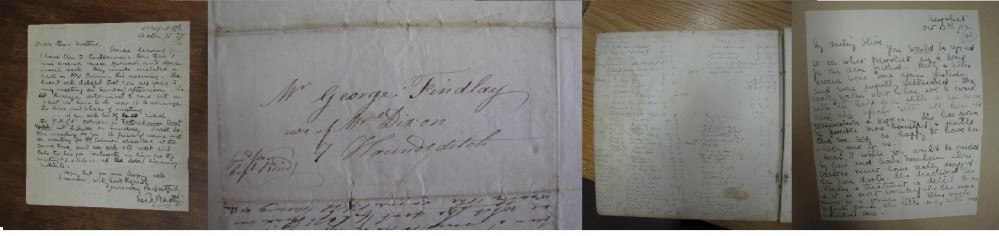
Forbes diary: working conventions
Please reference as: Liz Stanley (2019) ‘Forbes diary: working conventions’ www.whiteswritingwhiteness.ed.ac.uk/Collections/Collections-Portal/Forbes-Diary-Collection/Forbes-Diary-Conventions and provide the paragraph number as appropriate when quoting.
Guides to the Forbes diary are:
- The Forbes diary in a nutshell
- Introducing the Forbes diary
- Forbes diary dramatis personae
- Forbes diary overviews
- Forbes diary: working conventions [this]
1. The Forbes diary
1.1 The Forbes diary is a unique source of information, both about the details of white settler life in the south eastern Transvaal over the lengthy period from 1850 to 1918, and also concerning the light the diary throws on the many other kinds of writing that the different, lively and entrepreneurially-minded members of the Forbes family and their associates also produced.
1.2 As a consequence of the importance of this fascinating and monumental document, a detailed and fully searchable electronic version of the diary has been produced, which records detailed notations, and for a large sample full transcriptions of all the entries across all the years it was written. This has been a major undertaking, requiring a significant investment of time and energy on the part of the Whites Writing Whiteness project, and one that has been well worthwhile.
1.3 The first extant diary is dated 1850 and is a narrative of the migrant journey from Scotland to Natal undertaken by David Forbes, the writer, and his elder brother Alexander. The last is dated 1917 and also contains January and February 1918 entries, and was written by Kate Forbes nee Purcocks, a redoubtable woman and very professional farmer who married David Forbes in 1857. In the period between, there are many other fascinating volumes, written by either David or Kate, or exceptionally by one of their adult children or a farm manager. There are twenty-four volumes of diary that have survived, one or two fairly short and covering specific time-periods, but the majority are year-diaries, with most having an entry for every day of the year.
2. Dates and diary pages
2.1 The Forbes diary is very large, both in terms of numbers of diaries, and regarding the volume of dated entries that exist. Some of the individual year-diaries are written in notebooks with many dated entries on one page, and sometimes these entries run into each other, so that a text which starts in one dated entry is then almost seamlessly continued under another date. However, some of the later diaries are in a printed large-format ‘library diary’ with one page per day, while others are also in printed large format diaries but having two days per page, or perhaps two pages to record the dates for an entire week. And on the pages of these different kinds of physical diaries, sometimes dates appear but for which no entry has been made, and these can appear in the midst of other dates for which there are entries recorded.
2.2 This makes for complications in how best to record the dated entries. The approach that has been taken is consistent throughout and responds to these complications in a way that reflects how the entries have been written in each individual year-diary. This is to ensure that readers and users can have full appreciation of how the diaries have been written, including that diary pages are sometimes very complex with regard to the dates that appear on them. There is always a close interrelationship between the different entries; however, in many instances it is even closer, because pages may have multiple dated items written on them.
2.3 As a result, all the dated entries that appear on the same diary-page (whether there is text recorded for some of these dates or not) are recorded together in the database entry for the run of dates concerned. Thus, for example, if on one page of a diary the dates appear as Monday 12 September, Tuesday 13, Wednesday 14, Thursday 15 September, the date given in the database will appear as a range, 12 September – 15 September, even if there is no entry for, eg, Tuesday 13 September, so that the records and the transcriptions and/or summaries they provide accurately reflect the diary-pages on which they were recorded.
2.4 This provides readers and users with full information about the shape of the diary entries as they appear in manuscript form, rather than artificially putting every single date in a separate record in the diary database.
2.5 This, then, follows the diary-writer/s in what they have done, because this is the best way to convey the complexities of the writing practices engaged in and their relationship to the material object of the physical diary and its pages.
3. Entries, summaries, transcriptions
3.1 The database provides information about every entry that was written in every volume of Forbes diary:
- Minimally, a range of meta-data is given concerning such things as the date or date-range, writer, and place of writing, together with a fairly detailed summary of content which covers all the main points made in the entry.
- For other entries, selected as a purposeful Sample according to a specified set of criteria detailed in section D below, a full and detailed transcription is provided.
- Transcriptions contain an entry as close as possible to how it was written and therefore these include mistakes, insertions and deletions.
3.2 All of the shorter diaries from 1850 through to 1902 inclusive have been transcribed in full. Therefore no separate summaries have been provided for these, as the complete entries are available.
3.3 From the 1903 diary through to the 1917/1918 one, all entries have been summarised in detail; and in addition, some entries have been selected for full transcription and these are identified as ‘Sample’ because purposefully selected according to the criteria specified in section D.
3.4 The sole exception to this is the diary headed ‘1912 ^and 1913^’, written by Dave Forbes jnr, which has been transcribed in full for a specific reason. The entries in this are very clipped and bullet-point like, generally not written in proper sentences, and on occasions do not to have verbs. Any summaries of entries would need to expand the form of their expression, and the result in many cases the summaries would be longer than what Dave himself wrote in his entries. In addition, writing summaries for these would also take more time than simply transcribing the entries.
3.5 The decision was therefore made to provide transcriptions of all its entries, which can helpfully be seen as Dave’s summaries of what he thought the farm diary content should be like. However, the selection criteria below for identifying some entries as ‘Sample’ have been used regarding the ‘1912 ^and 1913^’ diary as well as all the others from 1903 on.
3.6 In addition, there are some gaps in diary-entries. These are generally very occasional. Where such gaps are longer than three days, rather than providing a succession of individual empty records there is a single record which indicates the date range during which no entry was written. They are:
1903: 1 – 4 January
1905: 13 – 17 March
1909: 11 July – 3 August; 13 – 16 October
1911: 7 – 10 February
1912: 9 – 28 April; 1 – 5 May; 7 – 13 May; 28 May – 1 June; 18 July – 24 December; 27 – 31 December
1915: 6 June – 16 July; 18 – 21 December
1916: 7 – 21 December
1917: 3 – 29 July
4. Sample selection criteria
4.1 The selection criteria used for identifying some entries as a purposeful ‘Sample’ are as follows:
- All entries that deal with matters of race and ethnicity and which show the complications and extremities of racism and/or ethnic inequalities have been transcribed and identified as Sample.
- All entries that provide examples of the use of racial and ethnic terminology regarding events, activities and persons have been transcribed and identified as Sample.
- Entries that show the relationships between members of the Forbes family and their different groups of workers, in the kitchen, kitchen garden, Home Farm, wider Estate and other farms have been transcribed and identified as Sample. These pertain to such things as:
- Activities and altercations involving workers, including workers being sacked or leaving and passes asked for, being issued or refused
- Events and parties involving the Kolwas/Christians living on Athole, and similarly so for those designated Heathen
- Life events of workers, including illnesses and injuries, dances and other social gatherings, weddings, births of children, deaths, marital/custody disputes, family networks
- Examples of key life events for the Forbes, such as deaths, births, weddings, major illnesses and so on have been selected as Sample, although not all of these have been transcribed.
- Examples of important or otherwise significance economic and business activities involving the Forbes, including the Forbes Reef, the coal concession and the Mining Company have been selected as Sample, although not all of these have been transcribed.
- Examples of significant local or wider events, including war and fighting at one end of the spectrum through to poaching, controversies concerning farm roads, railway routes and so on at the other have been selected as Sample, although not all of these have been transcribed.
- Examples of matters written about for potential use as legal evidence have been selected as Sample, although not all of these have been transcribed. These pertain to such things as:
- Detailed accounts of legal disputes with local area people
- Discussions of Wills and the legal apportionment of Forbes family farms to heirs
- Land and road disputes
- Fires and property damage
- Examples of entries concerned with people, events and activities that are out of the ordinary, extraordinary, shocking or terrible have been selected as Sample, although not all of these have been transcribed.
- At least one entry from every month that a diary was written in has been identified as Sample and transcribed. When temporal gaps existed after following the Sample selection criteria above, these additional entries were selected randomly.
5. Transcription conventions
5.1 Where complete transcriptions of entries have been provided, the broad convention that has been followed is to reflect as fully and accurately as possible the writing practices of the diary-writer.
5.2 In making the transcriptions, the mistakes, omissions, crossings out, insertions and deletions, capitalisation and lack of it that appear in many entries have been provided as fully and sensibly as possible. The only exception is that, where there are multiple spellings of the name of a particular person, these have been standardised in the summaries provided, although not in actual transcriptions of the diary-entries, which are as exact as possible. The existence of variant names has also been indicated in the dramatis personae.
Deletion = deleted word/s
^insertion^ = inserted words/s
?Doubtful = a doubtful reading of a word
[Word space] = a space has been left by the diary-writer to insert a word later but with this forgotten about
[Note: comment] = provision of an editorial explanatory comment
Last updated: 28 August 2019